
We ensure all students succeed in maths by giving them a high-quality mathematics education which provides foundation for understanding the world.
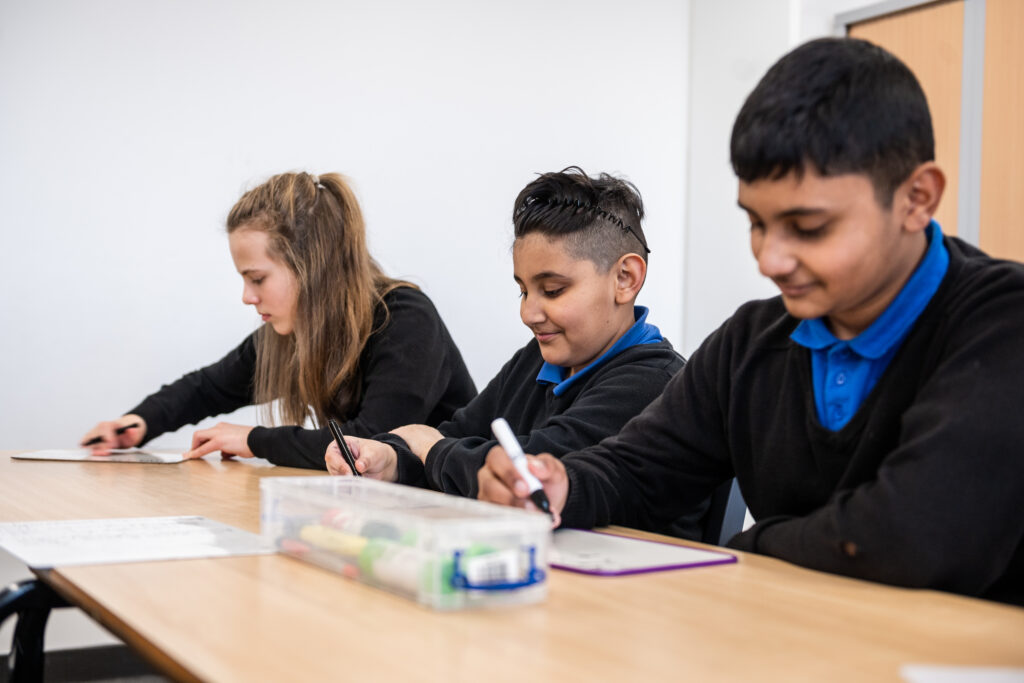
Students will develop their ability to reason mathematically while gaining an appreciation for the beauty and power of mathematics and sense of enjoyment and curiosity about the subject.
Maths is a remarkable subject to help students to develop an understanding of the universe, as they understand a language that describes and models the patterns and structures found in the world around them. Students will develop their ability to solve problems while gaining the skills to understand a technologically developing world, as mathematical algorithms, models and computations become essential for further technological development. While developing their cognition and critical thinking skills, they will also gain the ability to make positive financial decisions in the future.
Enrichment
To ensure all students are supported in their mathematical education, Period 6 sessions are offered to students to hone their knowledge and skills.
Other enrichment opportunities include a homework club, a trip to Bletchley Park (codes, ciphers and problem solving) and a potential trip to Paris.
Assessment
Summative and formative assessment will be used throughout KS3 and KS4 to monitor pupil progress and further inform teaching and learning.
KS4 Specification
Careers
We make links to careers in maths by making reference to the soft skills being developed such as teamwork, working to deadlines, communicating and problem solving. We also make reference to careers such as:
- Air traffic controller
- Engineer
- Architects
Curriculum Overview
| Year | Cycle 1 | Cycle 2 | Cycle 3 |
|---|---|---|---|
| Year 7 | Sequences | Graphing data | Speed, distance, time |
| Year 8 | Ratio | Area, volume, density | Angles in parallel lines and polygons |
| Year 9 | Properties of number | Maths and money | Pythagoras’ Theorem |
| Year 10 | Algebraic manipulation | Non-calculator methods | Angles |
| Year 11 | Ratio and proportion | Functions and graphs | Exam revision and strategy |