
All students learn essential disciplinary knowledge about the physical world around them through the three main subjects of Physics, Chemistry and Biology.
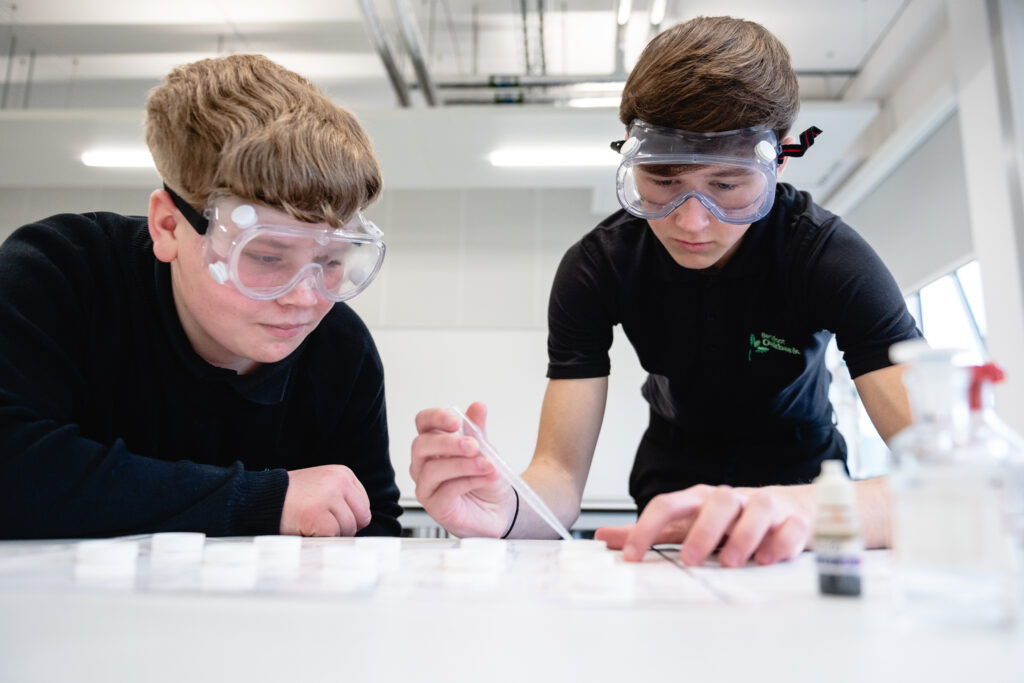
Students build up cumulative knowledge so that they can increasingly describe, explain, and predict in a scientific way. Through the application of the most objective human method of knowing, students are encouraged to be scientifically literate and curious beyond belief about the world in which they live.
Science is a remarkable subject to develop analytical thinking skills, read and interpret information, develop their scientific vocabulary and specialist terminology and appreciate the development in science and the interconnectedness with technology.
Enrichment
Students have access to a wide range of enrichment activities. These include:
- National Science Week competitions
- Lego robotics club
- STEM Year 7 Science Club
- Gardening club
- Access to the library
- Cross curricular reading clubs: Royal Society book club
Assessment
Summative and formative assessment will be used throughout KS3 to monitor pupil progress and further inform teaching and learning.
KS4 Specification
Careers
We make links to Careers in science: when we have visiting lecturers or during practical activities by reference to the soft skills being developed such as teamwork, working to deadlines, communicating and working safely. When pupils are practicing oracy tasks
in science lessons, we remind pupils of the need to speak coherently and clearly and why it is important in many jobs.
Curriculum Overview
| Year | Cycle 1 | Cycle 2 | Cycle 3 |
|---|---|---|---|
| Year 7 | B1.1 Cells | B1.2 Reproduction | P1.2 Space |
| Year 8 | B2.1 Tissues and organs | C2.2 Changing substances | C2.3 Earth systems |
| Year 9 | B3.1 Growth and differentiation | B3.2 Human interaction | B3.3 Genetics |
| Year 10 | B4.1 Digestion C4.2 Extraction of metals | P4.2 Energy conservation | B4.4 Health and disease |
| Year 11 | B5.1 Feedback and control P5.1 EM Radiation | C5.2 Controlling reactions P5.2 Force fields B5.4 Evolution | B5.4 Evolution |